
The Department of Labor's H-1B and PERM fraud probe raised the obvious question: what would an investigator find in your files? The firms that stay calm are the ones that already know - because they audit themselves first, and GlobalCodio keeps them ready by default.
On July 8, the Department of Labor opened its first major fraud investigation into the H-1B and PERM programs, putting every employer and immigration firm on notice. We covered what an investigation demands when it reaches your door. The more useful question to sit with now is the one you can act on today: what would an investigator find if you audited your own files first?
The firms that come through enforcement cycles intact tend to run that audit before the government forces one. It is the cheapest insurance available in immigration practice right now - far cheaper than a defense assembled after a subpoena. The catch is that for most firms it is nearly impossible to do by hand, because the evidence you would need to check is scattered across documents and systems that were never designed to be examined together.
What an internal audit actually checks
A real readiness audit is not a spot check. It confirms that the wage level, SOC code, worksite, and job title on the labor condition application match the petition and the offer letter; that the prevailing wage determination is documented and defensible; that PERM recruitment records and the audit file are complete; that payroll actually reflects the wage that was promised; and that every certified LCA has a Public Access File that is complete and retrievable. Each of those is a place where a small, unintentional mismatch becomes an audit finding.
Those mismatches are structural, not careless - the same facts entered at different times, by different people, into different documents, drifting slightly apart. That is a longer story we told in our companion piece on the investigation. The point here is simpler: an audit is where you catch the drift on your own terms, with time to fix it, rather than explaining it to an investigator years later.
Public Access Files are the quiet failure point
For every certified LCA, an employer must maintain a Public Access File and be able to produce it quickly on request. It is precisely the kind of obligation that is easy to deprioritize and painful to miss - a documentation failure rather than a substantive one, but penalized all the same. Knowing which files exist, what each one contains, and when each may be purged, across an entire caseload, is a recordkeeping problem before it is ever a legal one. Solve the recordkeeping and most of the legal exposure takes care of itself.
Readiness is a state, not a scramble
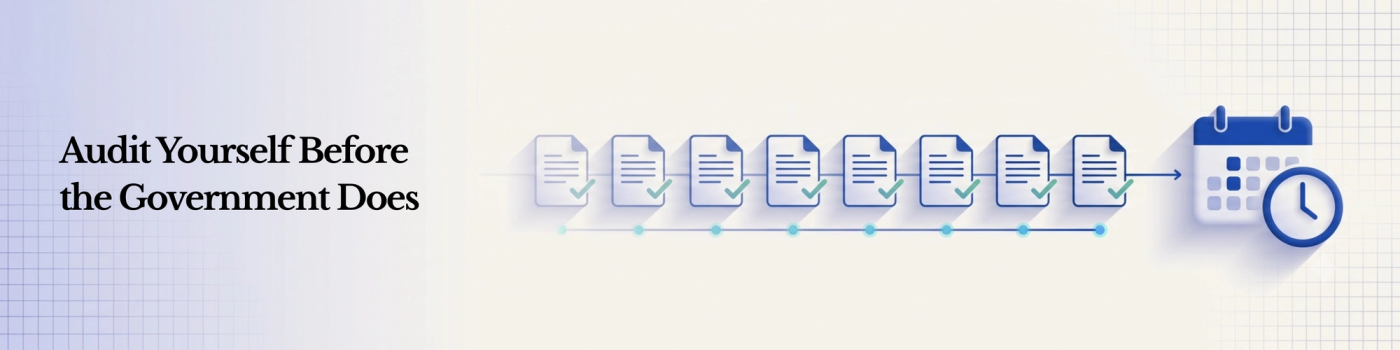
This is where GlobalCodio changes the shape of the problem. An audit stops being a project you launch and becomes the condition your caseload is already in. As each file is built, the Document Validation Agent checks it against its requirements and flags what is missing before anything is filed - so the checklist above is satisfied continuously, not reconstructed the week a subpoena lands.
The part most firms miss is the clock. Public Access Files and PERM audit files carry retention obligations - kept for a defined window, retrievable on short notice, purged only when permitted. The Deadline Agent tracks those windows across every matter, so nothing is destroyed early or held past its date, and no file is ever unaccounted for when someone asks to see it. Because every action is logged as it happens, the proof of what you did sits alongside the files themselves - not in someone's memory. Readiness becomes a state you maintain on a calendar you do not have to watch.
You cannot control when a subpoena arrives. You can control what it finds. The firms that will move through this cycle calmly are the ones for whom an audit is not an event to survive but a state they already hold - files consistent, records retrievable, retention tracked, every single day, whether or not anyone is asking. Building and running that state quietly in the background is exactly what GlobalCodio does.